Māori Grammar
| Previous | Back | Next |
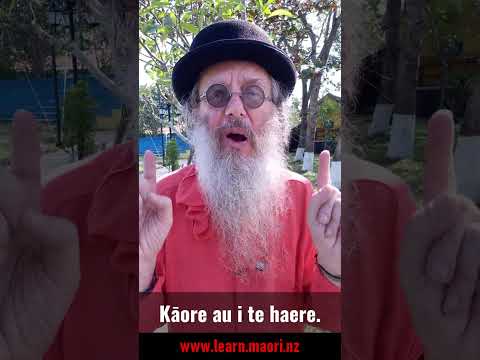
The past tense uses i te for an action that was in progress and i for an action or event in the past:
I te haere ia.
He was going.
I haere ia.
He went.
These are negated by kāore... i te... and kāore... i...
Kāore ia i te haere.
He was not going.
Kāore ia i haere.
He did not go.
Note that sentences in the present, using kei te, are also negated with i te. This means that a sentence with kāore... i te... might be negating either a past or a present action.
Kāore ia i te haere.
He/she was not going.
He/she is not going.
The correct meaning is determined by context:
Inanahi, kāore au i te haere.
Yesterday, I was not going.
I tēnei rā, kāore au i te haere.
Today, I am not going.
The word order changes in the negative sentence, with the subject coming after kāore and before the verb:
| Affirmative | Negative | |
|---|---|---|
| Past | I + verb + subject | Kāore + subject + i + verb |
| Past progressive | I te + verb + subject | Kāore + subject + i te + verb |
The subject of the sentence can be a name, a personal pronoun or a noun phrase:
Kāore a Rangi i haere.
Rangi did not go.
Kāore rātou i haere.
They did not go.
Kāore ngā tamariki i haere.
The children did not go.
The negation structure does not change in the singular or plural:
Kāore te kaiako i te waiata.
The teacher was not singing.
Kāore ngā kaiako i te waiata.
The teachers were not singing.
Additional information can be added to the sentence:
Kāore au i te haere ki te toa.
I was not going to the shop.
Kāore ngā tamariki i tākaro i te kēmu.
The children did not play the game.
Kāore te wahine i aroha ki te tāne.
The woman did not love the man.
Past-tense passive sentences are negated in the same way:
Kāore te keke i kainga e ngā tamariki.
The cake was not eaten by the children.
Kāore te kupu i kōrerotia e te tāne.
The word was not spoken by the man.
Kāore he tamaiti i whānau.
No child is born.Kāore te tama i oma ki te kura.
The boy did not run to school.Kāore ngā wāhine i noho ki te marae.
The women did not stay at the marae.Kāore ngā tamariki i kai i te parāoa.
The children did not eat the bread.Kāore ahau i haere me Pita.
I did not go with Pita.Kāore māua i whakatā i te whare.
We did not rest at the house.Kāore ia i tunu i te kai.
He didn't cook the food.Kāore ngā kōtiro i whakaaro he hangarau, engari i kata he tama.
None of the girls thought it was funny, but a boy laughed.Kāore ia i pānui i tāna mahi-ā-kāinga.
He didn't read his homework.Kāore au i maumahara ki te haora o te pahi tuatahi.
I can't remember the time of the first bus.Did you go to the shop?
Did you not go to the shop?Did you see the policeman?
Did you not see the policeman?Kāore ia i pānui i tāna mahi-ā-kāinga.
He didn't read his homework.Kāore a Taika i hīkoi ki te kura.
Taika didn't walk to school.Kāore au i hōhā i a koe.
I wasn't upset with you.Did they sing at the gathering?
Did they not sing at the gathering?Kāore au i kite i te kurī i te pāmu.
I did not see the dog at the farm.Kāore a Rangi i hoko i te waka.
Rangi did not buy the car.Kāore ia i oma.
She didn't run.Kāore mātou i haere ki te tāone.
We did not go to town.Kāore a Hemi i haere ki te whare pikitia.
Hemi did not go to the cinema.