Māori Grammar
| Previous | Back | Next |
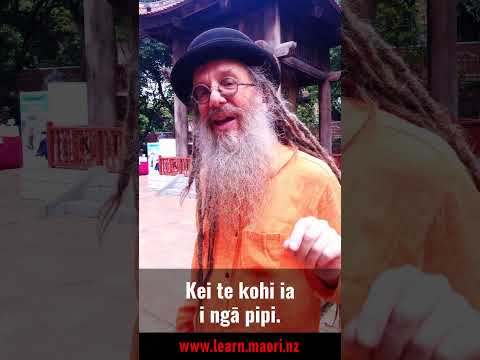
In English, a gerund is a verb form ending in -ing that functions as a noun: swimming, dancing, thinking, running, etc.
In te reo Māori, there is no direct equivalent of the English gerund. However, there are Māori sentence structures that may be translated into English using an -ing form.
For example, compare the following:
Kei te whakarongo ahau ki te wahine e waiata ana.
I am listening to the woman who is singing.
Kei te whakarongo ahau ki te wahine waiata.
I am listening to the singing woman.
In the first sentence, e waiata ana is a full verbal construction meaning "who is singing". In the second, waiata immediately follows wahine and describes the woman. It can therefore be translated into English using the participle singing: "the singing woman".
The same principle can occur when a verb is followed by its object.
The object of a transitive verb is typically marked with i:
Kei te tunu ahau i te keke.
I am baking the cake.
However, when the object is used in a more general or non-specific sense, i can be omitted:
Kei te tunu keke ahau.
I am cake-baking.
Here keke is still the object of tunu, but the absence of i gives the expression a more general or activity-like meaning.
I tākaro netipōro au.
I played netball.Kei te tope rākau ia.
He is chopping a tree.I whakapaipai whare au.
I did housework.E whatu hiripa ana taku kuia.
My nan is knitting slippers.E kiriweta wāhine ana ia.
He hates women.Kei te hī ika a Aroha.
Aroha is fishing.E kōrero pukapuka pea ana ia.
Perhaps she's reading a book.Kei te horoi rīhi ngā tamariki.
The kids are washing the dishes.Kei te whakamaroke ngā rīhi a Ari.
Ari is dishes-washing.E tunu parāoa ana a Amaru.
Amaru's baking bread.E rapu ipo ana a Hera.
Hera is love-seeking.Kei te pīnono ngā rare a Hēmi.
Hēmi is lolly-begging.Kei te rama tuna mātou ā te pō nei.
We are going eeling tonight.Kei te whai kiore te ngeru.
The cat is mice-chasing.Kua inu pia koe?
Have you been drinking beer?Kei te hanga taiapa rāua.
They're building a fence.E ruku pāua ana au nā te mea e haere mai ana tōku hungarei.
I'm going pāua diving because my mother-in-law is coming.Kei te ruku pāua a Ari.
Ari is diving for pāua.Kei te whakairi kākahu a Tame.
Tame is hanging out washing.E haere waiata ana rātou.
They were walking along singing.E inu wai ana ia.
She is drinking water.E kiriweti wahine ana ia.
He hates that woman.Kei te hanga whare rātou mō ō rātou mātua.
They are house building for their parents.Kei te tuhituhi reta kē ahau.
I'm writing a letter.E hī ika ana au ki tātahi.
I'm going to go fishing at the beach.E pōtarotaro pātītī a Pita.
Pita is lawn-mowing.Kua tuhi pūrongo rāua mō tā rāua haere.
They've written a report about their trip.E whakatō kūmera ana a Pou rāua ko Hema, e tākaro ana he rōpu tamariki i roto i te māra.
Pou and Hema were planting kūmera, and a group of children were playing in the garden.Tēnā pea, e kōrero pukapuka ana ia.
Perhaps she is reading a book.I eke paihikara au.
I rode a bike.E eke pahikara ana a Pāora.
Pāora is bike-riding.E pōutouto wahie ana ia.
He is chopping firewood.Kei te pānui puka te kuia.
The old lady is reading a book.Tēnei nā, e kōrero pukapuka ana ia.
She must be reading a book (to just by what I hear).E kōrero pukapuka ana ia.
She is reading a book.