Māori Grammar
| Previous | Back | Next |
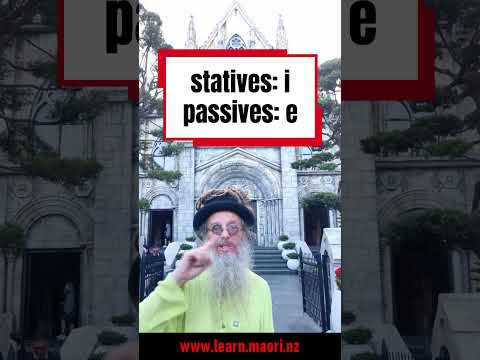
Statives are a family of verbs that have their own sentence stucture and can be confusing.
In a typical sentence without a stative, we have a subject (a person who is doing something) and an object (the thing that is having something done to it). For example, in the sentence "the boy drank the milk", the subject of the sentence is the boy (the one doing the drinking) and the object is the milk (the thng being drunk). In te reo we mark the object of the sentence with i or ki.
I inu te tama i te miraka.
The boy drank the milk.
In a stative sentence, it may seem that the subject and the object of the sentence are reversed. The word pau is a stative and means "consumed". To say "the boy consumed the milk" we would say:
I pau te miraka i te tama.
The boy consumed the milk.
Note that the paticle i now preceeds "the boy" rather than "the milk". The subject of the sentence is actually the milk and the obkect of the sentence, marked by i is the boy. This can be rather confusing!
Literally, the sentence means "the milk was consumed by the boy". If we were to put the particle i where you might expect, you would create a nonsensical sentence:
*I pau te tama i te miraka.*
The boy was consumed by the milk.
Another stative that can also confusing is pakaru, meaning "to be broken".
*I pakaru au i te matapihi.*
I was broken by the window.
I pakaru te matapihi i a au.
The window was broken by me.
The sentence should make sense if we remove the object, for example:
I pakaru te matapihi.
The window was broken.
I pau te miraka.
The milk was consumed.
Kua mahue ia.
She was left behind.
We can then add the object of the sentence, marked by i which will tell us who did the breaking, the consuming, or thing that left her behind:
I pakaru te matapihi i au.
The window was broken by me.
I pau te miraka i ngā tamariki.
The milk was consumed by the children.
Kua mahue ia i te tereina.
She was left behind by the train.
The following words are statives:
ea - to be settled
hinga - fallen down
hora - to be spread out
hū - to boil
kī - to be full
māhu - be floating
mahue - left behind
mākona - satisfied
māngare – to be lazy
maringi – to be spilt
mate – to be unwell; to be dead
mātaotao - to be cool
mau – to be used caught, grasped
māuiui - sick
mokemoke - to be lonely
motu - to be broken
mutu – to be finished or to be finished for the time being
ngaro – to be lost, to be absent
ora – to be well; to be alive; to be saved
oti – to be completed
pakaru – to be broken, to be shattered
pau – to be used up, consumed, all gone
reri - ready
riro – to be obtained, acquired
tata - almost nearly
tū - hit, wounded
tūreiti - to be late
tutuki – to be realised, fulfilled, achieved
wareware – to be forgotten
whara - to be wounded, hurt
whati - to be snapped
Statives can only be used with the tense markers ka, i and kua. Stative sentences with ka can either be past, present or future:
Ka māuiui au.
I was sick.
I am sick.
I will be sick.
Kua ngāo taku pene.
My pen is lost.Kua pakaru te matapihi.
The window has been broken.Kua kī tō puku?
Is your tummy full?Kua pau te miraka.
The milk's all gone.I mate ia ki te awa.
He died at the river.Kua kī taku puku.
My tummy is full.Kua pau te kai, kei te hoki te tokorua ki ō rāua kāinga.
The food has been consumed, the pair are returning to their homes.Āe, kua mutu au.
Yes, I've finished.I mate ia ki te hōhipera i Ākarana.
He died in hospital in Auckland.Kua mutu te tangi a te pēpi.
The baby's crying has finished.Tae rawa atu rātou, kua mate te koroua.
By the time they got there, the old man had died.Kua mutu ngā mahi.
The work is over.Ka mutu tā tātou mahi āpōpō.
Our work will be finished tomorrow.Kua pau te miraka.
The milk has run out.Ki te hinga te kāwanatanga, me whakahaere he pōti.
If the government falls, there has to be an election.Kua mate te Pirimia.
The Prime Minister has died.Kua hinga au?
Have I been defeated (lost)?Kua kī tō puku?
Is your tummy full?Kua hinga au.
I have been defeated.Kua whati tōku waewae.
My leg has been broken.Kua pau taku wītipiki.
My weetbix are used up.Kua kī tōku puku.
My tummy is full.Kua hū te wai.
The water has boiled.Ka mutu te kura.
School has finished.Kua mahue te kurī.
The dog has been left behind.Kei hinga koe!
You'll fall over!Kua ngaro taku pene.
My pen has been lost.Kua māuiui koe.
You are sick. You have become sick.Kua mutu te kai.
The food has finished.Kua mutu te horoi rīhi.
Washing dishes has finishedKua tutuki te mahi.
The job has been done.Kua mutu taku kai.
My meal is finished.Ka mau te ika.
The fish is caught.Kua hinga koe?
Have you fallen down?Kua mate te kurī?
Has the dog died?Ka mahue a Puhihuia i te taha o te tangata i a ia rā te patu pounamu.
Puhihuia was left beside the man who had the greenstone weapon.Kua tata hū te wai.
The water's almost boiled.Kua mate noa atu ia.
He has passed away.I wareware ngā rīwai.
The spuds got forgotten.Ki te mutu te ua, ka haere ahau.
If it stops raining I will go.Kua pakaru te wini.
The window is broken.