Māori Grammar
| Previous | Back | Next |
Kia has a variety of uses, one of which is as a mild imperative most commonly seen in the expressions kia ora and kia kaha:
Kia ora!
May you be well!
Kia kaha!
May you be strong!
This expresses a desired state or a wish for a certain outcome.
Often, a command is given by adding a passive ending to a transitive verb:
Horioa!
Wash!
Tapahia!
Chop!
However, statives cannot take a passive ending, and so a command cannot be given in this way. Instead, a command with a stative (including ora and kaha) uses kia:
Kia tūpato!
Be careful!
Kia mākona!
Be satisfied!


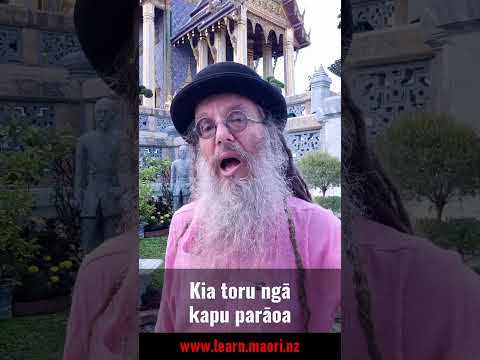

Kia au tō moe.
Have a sound sleep.Kia pai te rā.
Have a good day.Kia pai tētahi ki tētahi!
Be good to each other!Kia manawanui tāua.
Let us be patient.Kia piki te ora ki a koe.
May you be in perfect health.Kia tika āu raina.
Make your lines straight.Kia whakapapa pounamu te moana.
May the sea be like greenstone.Kia haumaru te haere.
Have a safe trip.Kia tere te tīmata.
Start quickly.Kia kaha ki te mahi!
Work hard!Kia karakia tātou
Let us do an incantation.Kia hāneanea te noho.
Have a comfortable stay.Kia tere ake tō oma.
Run faster.Kia taka pea koe i runga i te hōiho!
I hope you fall off your horse.Kia mahara ki te hē o Rona!
Let us remember the sin of Rona!Kia mā te wāhi e mahi ai kōrua.
Your work area should be clean.